
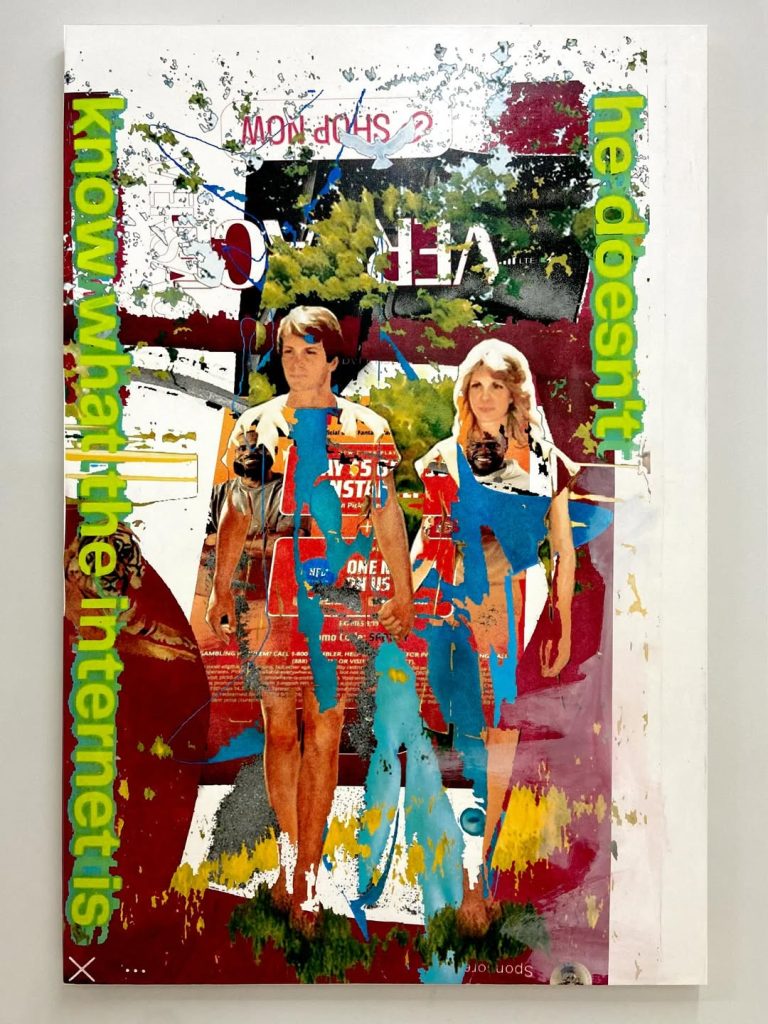

For Jaclyn and her family
The July afternoon sat on Chicago with a humid, brass-weighted insistence that made the stone facades along Michigan Avenue seem to exhale, as if the city’s mineral skeleton had been warmed through and now released a slow, invisible steam, and Eli, who had told himself he loved summer for its outwardness, its public theater of bare arms and loosened schedules, felt instead the season’s pressure as a kind of municipal hand laid on the nape, guiding him toward the Art Institute’s steps with their lion-guarded solemnity and their faintly judicial air. He had arrived early in that
anxious-earnest way he disliked in himself, the way a person becomes his own chaperone, and he stood at the edge of the plaza watching the crosswalk cycles, the tourist clusters, the
museum-goers in linen and sneakers, and he tried to picture how a date should look from a distance, as though the choreography could be learned by observing strangers who had rehearsed it longer. The building’s entrance banners flapped in a lake-fed gust that smelled of sunscreen,
bus exhaust, and distant water, and he thought of how the museum always advertised its
pleasures in the language of invitation while remaining, by architecture alone, a fortress of selection. Even the ticket line, with its patient shuffle and its discrete credit-card gestures, suggested a gated ritual, a passage from street-level contingency into curated quiet, and he wondered what it meant that so many people paid for the privilege of being told where to stand and what to contemplate. He adjusted the collar of his short-sleeved shirt, not because it needed adjusting, but because his hands needed employment, and because he feared the moment when his hands would become visible as hands, empty and asking. He glanced at his phone and then
slipped it away, feeling the small shame of seeking reassurance from a rectangle when the city itself was offering a vast, unsorted, uncaptioned spectacle.
Marisol texted that she was “two minutes out,” and when she appeared from the direction of the park she looked, to him, like someone who had stepped out of an entirely different temperature, her gait quick and buoyant, her hair pinned up in a way that made her neck seem longer than it probably was, and her dress a pale, summer-credible fabric that caught light without reflecting it. She was younger, yes, and that fact arrived in him not as a judgment but as a constant recalculation, the way a mind keeps rebalancing a scale when one side has been nudged, and he worried that any compliment he offered would sound like a comment from above, a verdict rather than a noticing. Her earrings, small gold arcs, swung when she smiled, and the smile itself carried an unembarrassed directness that made him feel briefly like the hesitant one, the shy one, the person with too many footnotes.
The museum lions watched them with their permanent granite skepticism, and Eli felt the old Chicago contradiction: the city that sells itself as friendly while building monuments that look as though they were designed to intimidate weather. Around them, couples posed, families corralled children, and solitary visitors moved with that purposeful drift of people who have decided to spend money on contemplation, which always, in practice, becomes a complicated form of consumption. Eli imagined the gallery they were headed toward, the special exhibition on Henri Matisse, and he thought about how a painter’s name could become a kind of currency, minted long after the person’s death, passed between institutions and patrons, insured and transported
like a jewel. He also thought, with sudden irrational tenderness, that Marisol had chosen to be here with him rather than anywhere else the city offered, and that choice, however provisional, was a gift that did not need to be repaid immediately.
“Sorry, I ran because the bus did that thing where it pretends it’s coming and then it’s not,” Marisol said.
“You’re not late,” Eli said. “I was early in a way that should be illegal.”
“You look like you’re about to testify in court,” she said, eyes flicking to the lions, then back to him. “Except the jury is made of tourists.”
“Then I plead guilty to overthinking,” he said.
They moved up the steps, and the air changed as they entered, becoming cooler, filtered, a museum-air that always seemed to carry a trace of varnish and quiet labor, and Eli noticed how quickly Marisol’s attention shifted from the exterior performance of arrival to the interior
seriousness of looking, as if the building had tuned her to a different frequency. He watched her scan the signage for the exhibition, and he felt, with a mixture of admiration and unease, that her ease with art was not the ease of someone trained to recite facts, but the ease of someone who had given herself permission to feel without asking for approval. In him, looking had always
come with an anxious apparatus: the fear of missing what was “important,” the suspicion that other people saw more, the impulse to translate sensation into explanation before it could be judged insufficient, and he recognized that this apparatus was a kind of class inheritance, not in the crude sense of income alone but in the deeper sense of how one learns to behave in rooms built by someone else’s money. The museum’s polished floors reflected ankles and shoe soles, and he caught himself thinking about the invisible workforce that kept the sheen alive, the
early-morning mops, the late-night trash bags, the security staff standing for hours while visitors
drifted past in soft intellectual leisure. He wanted to tell Marisol that he noticed these things, that he refused the fantasy of pure beauty detached from the labor that frames it, but he also feared that announcing his awareness would turn it into a badge, a performance of virtue that asked her to applaud. Her expression, as they approached the exhibition entrance for the Henri Matisse retrospective, remained open and alert, and he took that as instruction: attention first, speeches later, if ever. A docent’s voice floated from a nearby corridor, a gentle institutional murmur, and it made him think of how museums domesticate intensity, how they teach you to whisper even when your mind is shouting.
“So,” Marisol said, slowing by the wall text. “Are we doing the responsible thing and reading this, or the fun thing and pretending we already know everything?”
“We can do the irresponsible fun thing and then come back to the wall text when we feel guilty,” Eli said.
“Deal,” she said. “But if I mispronounce something French, you can’t look pained.”
“I’ll look deeply impressed,” he said.
Inside, the museum light shifted again, becoming a carefully engineered brightness that made colors behave, and Eli felt the immediate oddity of the exhibition: the sense of entering a corridor of decisions, each frame, each label, each sightline the result of committee meetings, shipping arrangements, donor negotiations, and curatorial argument, all of it hidden behind the illusion of effortless order. The first works drew Marisol forward with a kind of gentle magnetism, and he followed, noticing how she leaned in without touching, how she held her
hands behind her back as if
to keep her body from interrupting her eyes. Paint, in this setting, became more than oily pigment; it became a record of permission granted to the artist, and Eli found himself thinking about the historical pipelines that fed that permission, the way certain men were given rooms, time, models, travel, and an audience trained to call their experiments genius rather than indulgence. Yet the canvases also refused simple resentment, because the colors carried their own argument, their own defiant music, and he felt the familiar split: the mind wanting to
critique the apparatus, the body wanting to surrender to the radiance. Marisol’s upbeat face, seen in profile under gallery light, looked both younger and older than he remembered from coffee the week before, younger because of its unguarded curiosity, older because curiosity itself can be a practiced resilience, a way of insisting on more than what the day offers. He wondered, abruptly and almost comically, whether he was allowed to be moved without first proving that he understood the politics of being moved, and the question irritated him because it sounded like a doleful bureaucrat inside his skull. A couple nearby whispered about “ figurative composition,” and the word landed with the dryness of a term learned for an exam, while Marisol simply said, under her breath, “That color is impossible,” and Eli felt his chest loosen.
She pointed at a figure rendered with an economy that was almost rude, as if the painter had decided that fidelity to detail was a trap, and she said, not quite smiling, “He’s like, ‘I could paint your elbow perfectly, but why would I, when I can invent a new cadmium red?’”
Eli watched her finger hover in the air, never quite indicating too precisely, respecting the museum’s invisible rules, and he thought about how a series of rules create a dance, how prohibition can produce elegance, and how women, especially, are trained to navigate space with a constant awareness of boundaries that men often discover only when an obvious sign tells them. He wanted to say that her remark was brilliant, but “brilliant” felt like a spotlight, and he
did not want to turn her into a venerable object of his praise in the same room where so many women had been turned into objects of someone else’s male gaze. Instead, he said, “Inventing a new red feels like a kind of theft from reality, but also a gift to it,” and he regretted the line immediately because it sounded like something printed on a tote bag. Marisol didn’t flinch, though; she nodded as if he’d offered a usable thought rather than a performance, and she said, “Yeah, like you steal it and then you return it improved,” and Eli felt, with surprising relief, that she was willing to let him be awkward without punishing him for it. The gallery hum, the soft footfalls, the controlled climate, all of it made time feel thick, almost edible, and he realized that he was measuring the date not by minutes but by the quality of their shared silence, by whether silence felt like absence or like agreement. Marisol lingered at a work that suggested interior space, and Eli found himself thinking about interiors more broadly: who gets to have them, who gets to decorate them, whose domestic labor becomes background for someone else’s artistic freedom. Somewhere in the museum, a café line formed, money exchanged for sugar and caffeine, and the whole institution kept turning, a polite machine that converts attention into
prestige and prestige into funding.
“This one feels like a room that’s too hot,” Marisol said. “Like the air is stuck in it.”
“And yet the colors are cooler than the idea of the room,” Eli said.
“You’re doing the thing where you talk like a label,” she teased, gently.
“I’m sorry,” he said. “I can also talk like a person who dropped his brain down a stairwell.”
“Good,” she said. “Because I like that person better.”
He laughed, and the laugh startled him by being genuine rather than strategic, and in that moment he sensed the deeper complication he had been avoiding: that he wanted Marisol’s regard not merely as romantic confirmation but as a kind of absolution from derision, a proof that he could be decent, interesting, alive, and that wanting this proof was itself a form of hunger shaped by a culture that teaches men to collect women’s attention as if it were currency. He watched her look, and he felt the slight sting of envy at her directness, at how she did not seem to require an internal jury to approve each sensation, and he also felt the tenderness of someone witnessing a person make a world out of a full gamut of colors. The exhibition, for all its beauty, carried the faint shadow of elsewhere: the histories that brought patterns, textiles, and motifs into European studios, the way “exotic” became a decorative category that drained living cultures into aesthetic resources, and Eli did not need to name the process to feel its chill. Marisol, standing before a work with a figure posed in a manner that suggested both languor and staging, said quietly, “I always wonder how much of this is desire and how much is possession,” and Eli felt his throat tighten because she had spoken the thought he’d been circling without landing. He looked at the painted body, the stylized curves, the way the image invited a gaze and then trapped it, and he thought about how museums can turn intimacy into spectacle while insisting on curatorial civility, and can make erotic history safe by placing it behind glass and under guard. He also thought about Marisol herself, how she occupied her own body with a kind of
self-ownership that made him aware of his responsibility, and how the age difference, small in numbers, could still carry a cultural weight, a pattern of expectation he did not want to reenact.
“My aunt would hate this,” Marisol said, still looking. “She’d say, ‘Why is she lying there like that, like she’s waiting to be bought?’”
“And would your aunt be wrong?” Eli asked.
“She’d be right and also… she’d miss the part where the paint is doing something weirdly tender,” Marisol said. “Like it’s flattering her and mocking her at the same time.”
“That’s the part that makes me uncomfortable,” Eli admitted. “The tenderness that might be just another trick.”
“Or the tenderness that’s real but trapped inside a bad structure,” she said. “Like a plant growing through concrete.”
They moved on, and Eli noticed how their interesting conversation had shifted from playful to sharp without becoming sour, as if the gallery allowed them to speak more honestly because the paintings provided a third presence, a shared object that absorbed some of the risk. He found himself thinking about his own impulses on dates, how he tended to offer knowledge as a shield, how he used art-talk to avoid revealing his softer uncertainties, and he wondered whether this habit was a way of keeping control in a world where control is taught as a masculine virtue.
Marisol, on the other hand, seemed to treat ideas as tools rather than armor, picking them up, testing their weight, setting them down, and Eli felt both humbled and invited. The museum’s careful lighting made every surface look intentional, and he thought about intention as a moral category, the way people excuse harm by claiming they “didn’t mean it,” as if meaning were the only thing that mattered, as if impact were a rumor. He glanced at Marisol’s hands again, at the way she held them when she listened, and he realized that his attraction to her was braided with a desire to be corrected, to be seen and adjusted,
which was unfair to her because it made her into a teacher when she had not signed up to instruct him. A security guard passed, expression neutral, and Eli thought about neutrality as a pose
available mostly to those paid to enforce it, about how the museum asked certain bodies to be present as a classified function rather than as visitors. Somewhere behind a wall, an HVAC system whispered, and he imagined the building as a huge lung, breathing in money and breathing out quietly.
“I keep thinking about how much it costs to see this,” Marisol said, surprising him again. “Not just tickets. Like, the whole thing.”
“You mean the shipping, the insurance, the donors, the… machine,” Eli said.
“Yeah,” she said. “And I still want to see it. That’s what annoys me.”
“That annoyance feels honest,” he said. “Maybe it’s better than pretending the machine isn’t there.”
She smiled, and the smile had a quick glint of irony, the kind that says, we live inside contradictions, don’t we, and Eli felt that glint entered him like a small, useful splinter of wood. They paused in front of a piece that seemed to refuse an unobfuscated narrative, a field of color and shape that suggested movement without depicting it, and Eli’s mind, always eager to
domesticate sensation, tried to translate the work into language, then tried to make it behave like a facetious argument. But language, in that moment, seemed clumsy, a heavy cart trying to
follow a dancer, and he let himself simply stand beside Marisol and breathe the conditioned air, letting the work remain stubbornly itself. He noticed the subtle way she shifted her weight from
one foot to the other, and he imagined the story of her day before arriving here: the commute, the outfit chosen, the decision to say yes to him, and he felt, briefly, the enormity of other people’s lives, their private continuities that do not pause for your urgent romance. He also felt the strange intimacy of looking at the same object, the way shared attention can become its own form of touch, especially in a room where actual touch is forbidden. A child’s voice echoed from a distant corridor, a bright, rebellious sound, and Eli thought about how museums teach children to behave, how they train future adults to treat culture as something fragile and owned, and he wondered what it would mean to build a world where beauty was not guarded like property.
Marisol leaned closer to the label and then stepped back, and Eli did not ask what she read; he waited, trusting that she would speak when she wanted.
“I don’t want to sound dramatic,” Marisol said, “but sometimes I think the museum is like a bank, and the paintings are the gold, and we’re allowed to look at the vault if we’re polite.”
“That’s not dramatic,” Eli said. “That’s… accurate in a way that makes my stomach do something.”
“Mine too,” she said. “But also, I like being in the vault.”
He understood, and he felt the swelling tenderness again, the unwillingness to surrender beauty simply because treacherous beauty has been monopolized, the stubborn insistence that pleasure can be reclaimed even when the conditions are compromised. They wandered toward a section where the color seemed to grow louder, and Eli’s thoughts, in their long looping way, began to braid the date into something larger: the bustling city outside with its inequities stacked like
invisible scaffolding, the formal museum inside with its calm hierarchy of what counts as
“masterly,” the two of them walking between these systems while trying, in the small space of an afternoon, to treat each other as subjects rather than as roles. He knew that he could not solve anything by being aware, that awareness could become its own addictive narcotic, a way of feeling superior while changing nothing, and he felt a quiet fear that he might be the kind of person who confuses critique with courage. Marisol, however, kept returning to the paintings with a kind of practical devotion, as if looking itself were an action, and he wondered whether he had underestimated the moral value of attention. The work before them, whatever its subject, seemed to insist on the right to rearrange the world, and Eli thought about rearrangement as a political dream, about how some people are allowed to shuffle things around while others must endure. He imagined Marisol leaving the overwhelming museum later and returning to her simpler life, to her daily obligations, to whatever economic gravity held her days in place, and he felt an urge to make the date “worth it” in a way that was suspiciously transactional, as if he owed her a return on investment. That compensatory urge, he recognized, was another inheritance: the idea that time must be justified, that pleasure must earn its keep.
When they finally drifted toward the exit of the exhibition, the corridor beyond felt almost too ordinary, as if the rest of the museum had been dimmed by comparison, and Eli realized that he had been holding his body in a particular way, a posture of carefulness, and that his poised
shoulders ached from it. The summer light outside would be sharper, louder, full of honking and sirens and the metallic chatter of trains, and he felt a brief reluctance to leave the curated hush, not because he wanted to hide, but because the hush had given them a pocket of intimacy in a city that otherwise demands speed. Marisol stepped beside him, close enough that he could feel the warmth of her presence without touching her, and he wondered whether he should reach for her hand, whether that gesture would feel natural or rehearsed, and he hated that he was still asking permission from an imaginary audience. He chose, instead, to say, “Do you want to sit
somewhere and talk about what we saw, or do you want to let it stay wordless for a while,” and
he surprised himself with the question because it did not contain a plan, only an opening. Marisol looked at him for a long moment, and in that moment he felt the delicate tension of choice, the way a date can become a small referendum on trust.
“I want some coffee,” she said. “And I want to talk further. But not like a lecture. Like… like we’re both still inside the colors.”
“Then coffee,” Eli said. “And we stay inside the boundaries for all those colors.”
“Also,” Marisol added, eyes bright, “I’m going to mispronounce at least three things on purpose, just to keep you humble.”
“Thank you,” he said. “Humility is my newfound hobby.”
They walked toward the museum café and then, deciding against the line, turned instead toward the doors that led back to the eagerly awaiting city, and as they stepped out into the cutting sunlight the blasting heat hit them like a blunt instrument, and Eli felt the sudden comic contrast
between the museum’s controlled climate and the street’s unruly weather. The lake breeze arrived a second later, merciful and saltless, and Marisol lifted her dainty face to it as if to drink it, and Eli watched her with a quiet gratitude that did not need to be spoken. The date, he understood, would not be saved or ruined by a perfect gesture, because perfection was another form of subverting control, and that specific type of control was precisely what he was trying as his angle in his dating approach, in his better moments, to unlearn thoroughly. Behind them, the Art
Institute stood with its lion-guarded authority, and ahead of them the vibrant city spread out in all
its layered injustice and stubborn beauty, and between those two facts they walked side by side, not as symbols, not as moral examples, but as two people as a couple trying to be present in a world that constantly turns modest presence into a carefree performance of sincere love.
———————————————————————————————————————
Albert Abdul-Barr Wang Author Bio: Albert Abdul-Barr Wang is an indigenous
Taiwanese-American Los Angeles-based Oulipo-influenced poetic bard, experimental writer, and visual artist. His artworks, prose, and poetry have appeared or are forthcoming in TIMBER, The Adroit Journal, New Delta Review (NDR), BRINK, Clockwise Cat, Ekphrastic Review, The Hooghly Review, Brooklyn to Gangnam, and fractured lit. His piece “Bryan Betancur, Insider 2160” was
longlisted for the The Masters Review’s 2025 Summer Short Story Award for New Writers judged by Jennine Capó Crucet.